Shipping connectivity has shifted sharply across parts of Africa, the Middle East and the Indian Subcontinent as geopolitical disruptions force container shipping lines to redesign their networks and move transshipment activity away from affected regions.
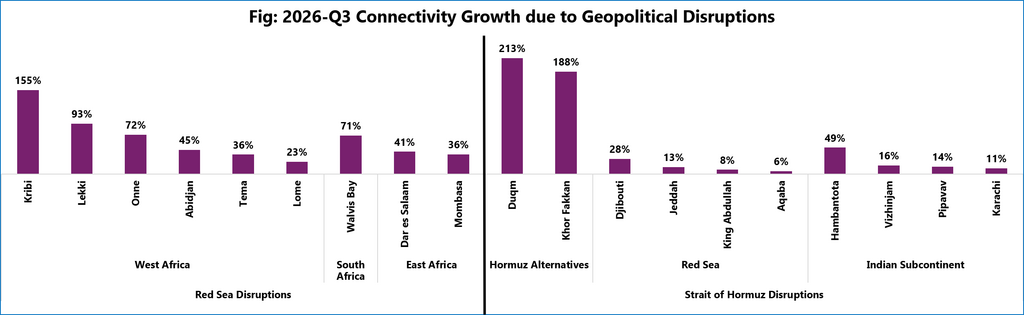
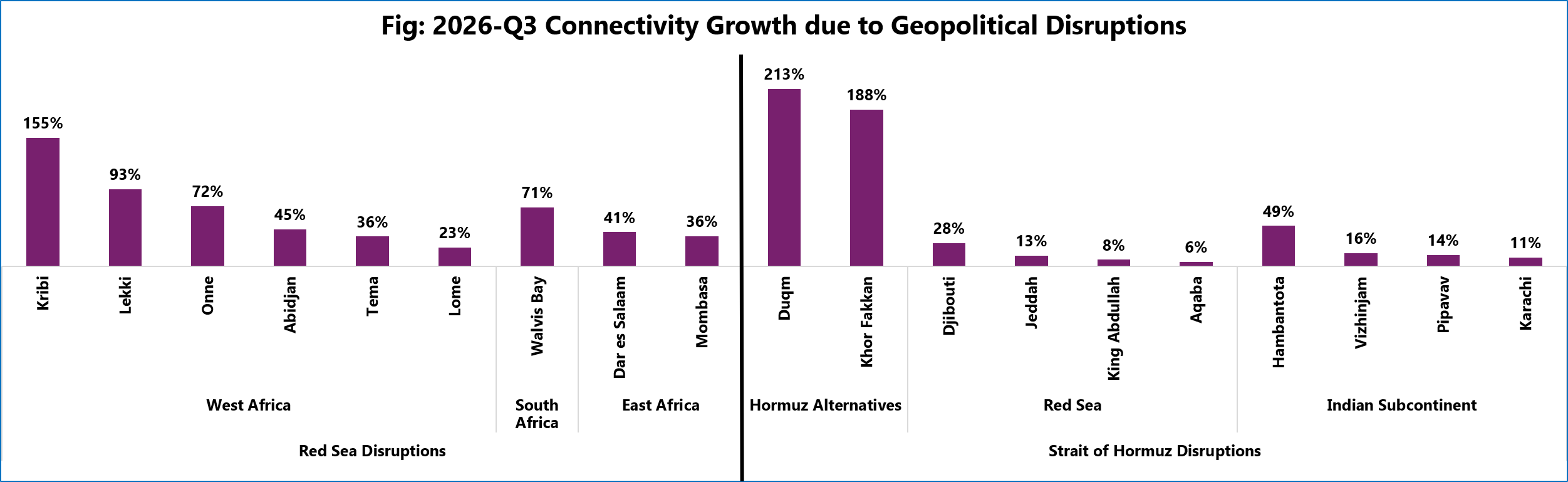
Sea-Intelligence, in its latest Sunday Spotlight commentary, highlights data from UNCTAD’s Port Liner Shipping Connectivity Index showing substantial connectivity growth at alternative ports during 2026-Q3. The comparison uses the final full quarter before each disruption as the baseline: 2023-Q3 for the Red Sea crisis and 2025-Q4 for the Strait of Hormuz closure.
With vessels bound for the Central and Eastern Mediterranean facing significant transit-time penalties when routing through the Strait of Gibraltar, carriers have shifted African relay operations further south along the Atlantic coast. This has contributed to strong connectivity gains at West African ports.
Walvis Bay has also emerged as an alternative to congested Durban for Asia-Europe services sailing around Africa. Elsewhere, ports around the Gulf of Oman have recorded some of the largest increases following the closure of the Strait of Hormuz.
Compared with their pre-crisis baseline, Duqm recorded a 213% increase in connectivity, while Khor Fakkan rose 188%, making them the strongest performers highlighted by Sea-Intelligence.
Ports in East Africa and the Indian Subcontinent have also benefited as shipping lines seek hubs outside the conflict-affected region. Dar es Salaam and Hambantota have gained connectivity as they handle displaced regional cargo and provide alternative routing options.
The figures illustrate how geopolitical shocks can quickly reshape liner networks, with connectivity moving away from disrupted locations towards ports capable of supporting alternative routes and regional cargo flows.
Source: Sea-Intelligence, Sunday Spotlight, “Connectivity: Shocks vs. Policy Shifts,” 8 October 2026.