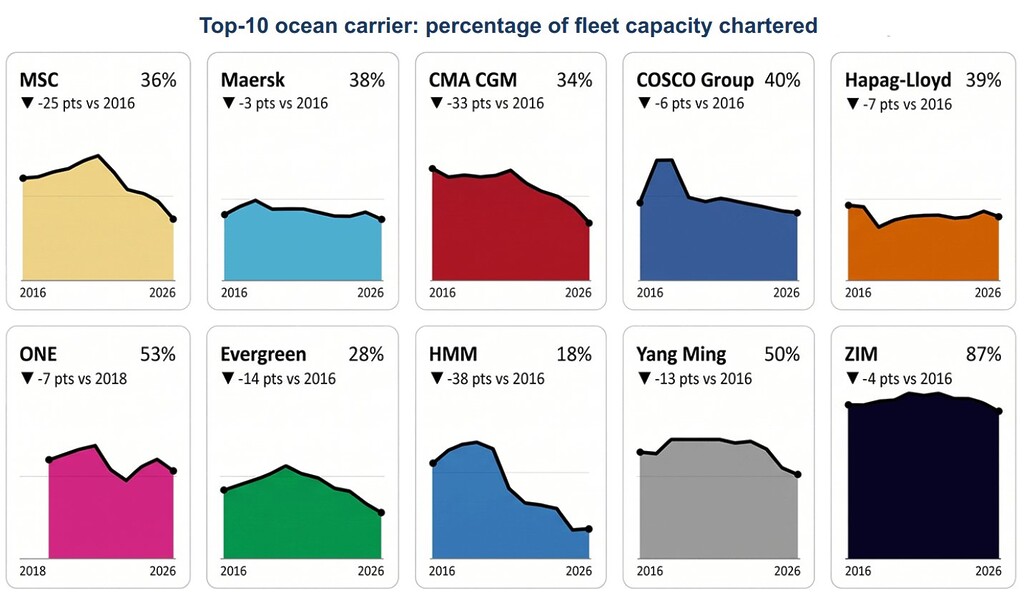
Chartered tonnage now represents a smaller share of the fleets of many leading container carriers as shipping lines continue expanding owned capacity, according to Alphaliner.
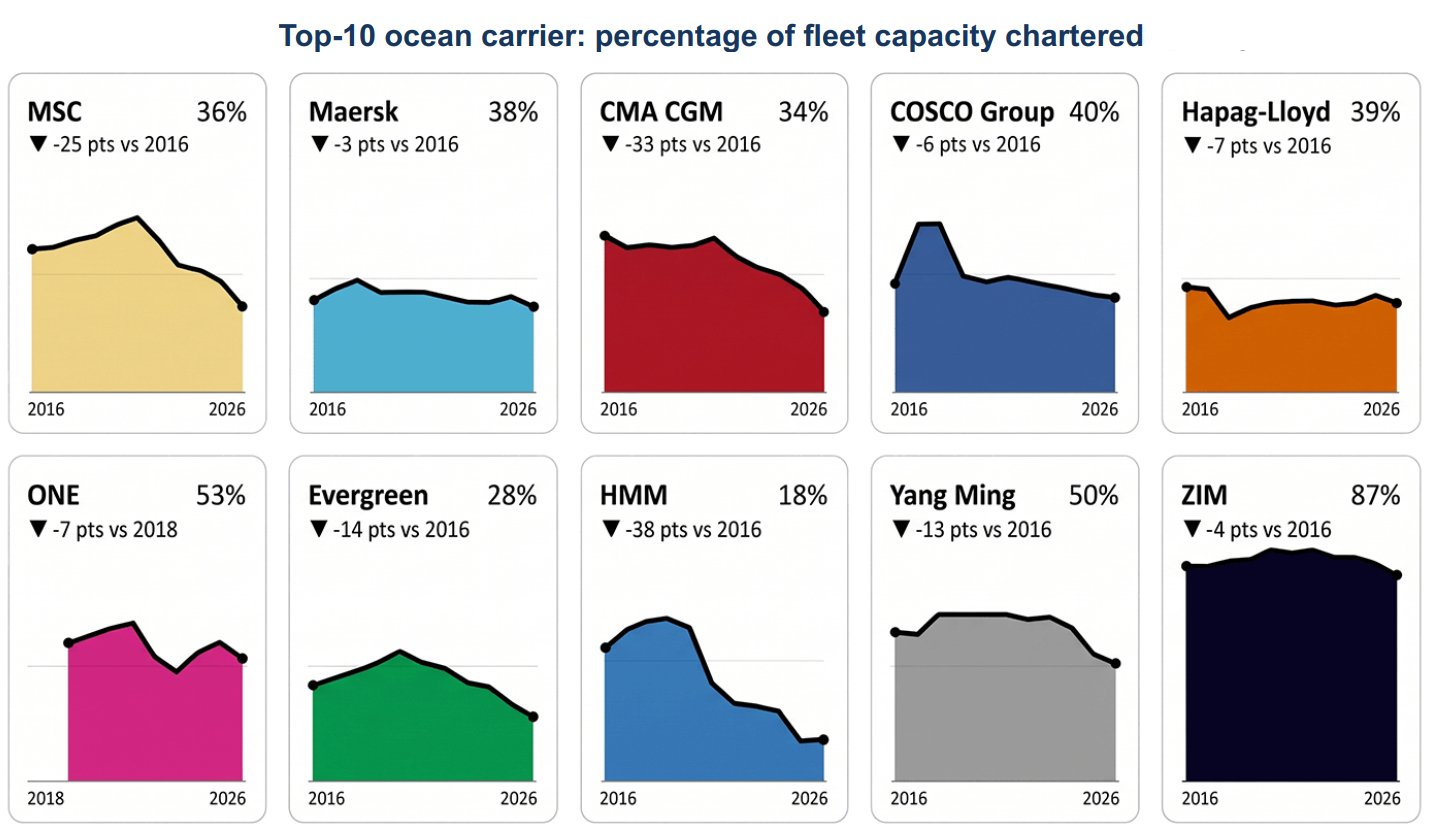
Chartered container tonnage is losing the favour of the Top-10 container shipping lines. Since 2021-2022, the share of chartered capacity in most of the biggest carriers’ fleets has been falling, sometimes in a drastic way.
Thanks to the extraordinary profits shipping lines achieved in the post-Covid cargo boom, many started growing their fleets by investing in newbuilding container vessels and second-hand ships. The move allowed them to cut their dependence on chartered tonnage and increase control on their fleets.
Whilst the operated capacities of the Top-10 carriers typically included 40-70% on charter ten years ago, this bracket is now down to 18-50%, with some shipping lines having cut their exposure in recent years more than others. The chartered fleets of the Top-5 carriers now stand between 30 and 40% of their deployed capacities.
Among the carriers who slashed their chartered exposure the most is South Korea’s HMM. Whilst the shipping company had 56% of its container fleet on charter, in capacity terms, in 2016, it is now less than 20%. After the collapse of Hanjin, the South Korean government propelled HMM to the position of Korean flagship carrier, supporting a massive fleet expansion that included the purchase of multiple newbuilding vessels, 59 so far.
CMA CGM saw the second largest drop, with the share of chartered tonnage falling from 67% of its operated fleet in 2016 to around 34% today. Most of the downfall started in the aftermath of the Covid pandemic, with huge profits allowing the carrier to invest massively in owned tonnage.
The buying spree included 160 second-hand container vessels so far, while 100 newbuilding containerships, ordered for its own account, joined its network. The French carrier remains nonetheless a major user of non-operating owner (NOO) tonnage with an active presence in the charter market.
MSC has seen its share of chartered fleet drop from 61% in 2016 to 36% today, a 41% fall. However, when looking at the share of the fleet on charter to MSC during Covid (around 75%), compared with the current 36%, the Geneva-based carrier has literally halved its charter exposure in the last five years.
Source: Alphaliner