On 14 October, United States Trade Representative (USTR) actions to “reverse Chinese dominance and to restore American shipbuilding” will be enforced.
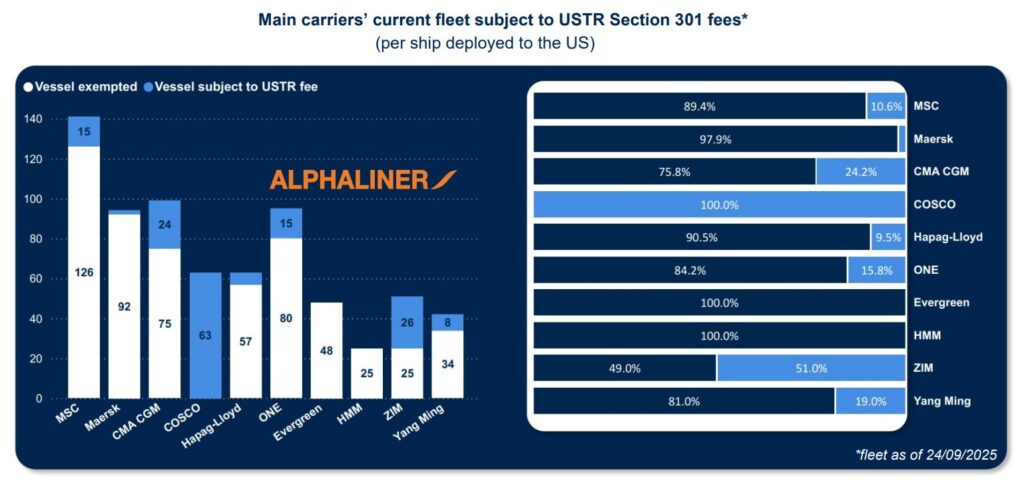
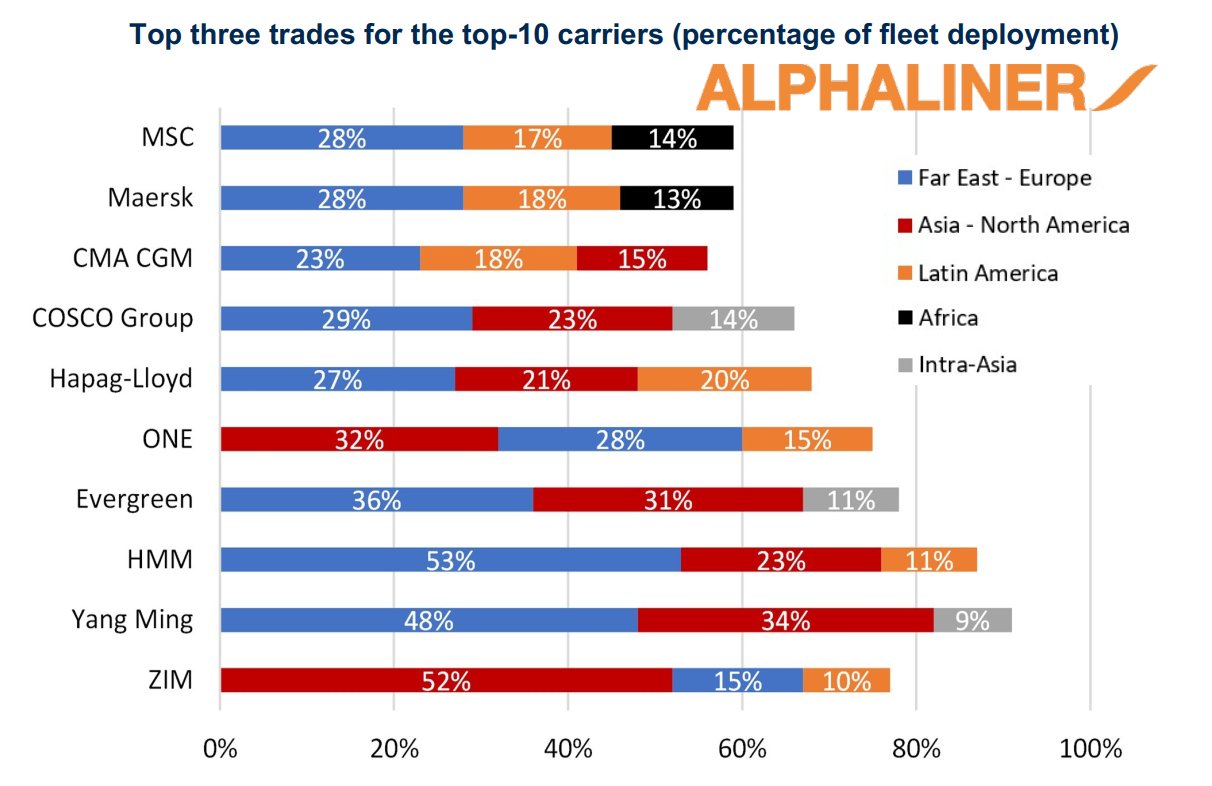
To highlight the potential economic impact on the main container shipping companies, Alphaliner in this week’s edition has calculated the theoretical fees that carriers would face in 2026 if they maintained the same fleet deployment to the US as today.
Under USTR section 301, vessels owned or operated by a Chinese entity in 2026 will face a flat fee of $80 per net tonnage (NT) per voyage performed to the US. At the same time, non-Chinese operators of Chinese-built ships will be charged the higher amount of either $23 per NT or $154 per teu capacity. Both fees are imposed on a ship no more than five times a year.
Based on the current deployment, COSCO Group remains clearly the most threatened by the fee as its fleet would be subject to $1.53bn of the aggregated $3.20bn due from the top-10 carriers should their fleet deployment remain unchanged next year.
The fleets of ZIM, ONE, and CMA CGM servicing the US would respectively be subject to $510m, $363m and $335m in fees, reflecting the fact that the operators deploy a large share of ships chartered from Chinese shipowners, and thus fall under the first category of sanctions.
The French carrier plus MSC and Yang Ming meanwhile operate a substantial fleet of, not Chinese-owned but Chinese-built ships, which would incur an additional $50m, $73m and $48m in fees in 2026.
In the current scenario, Gemini Cooperation partners face a different situation. While Maersk’s fleet would “only” be charged $17.5m, some $105m in fees would be imposed on Hapag-Lloyd’s fleet in 2026, mainly due to the amount of its Chinese-owned units.
Source: Alphaliner