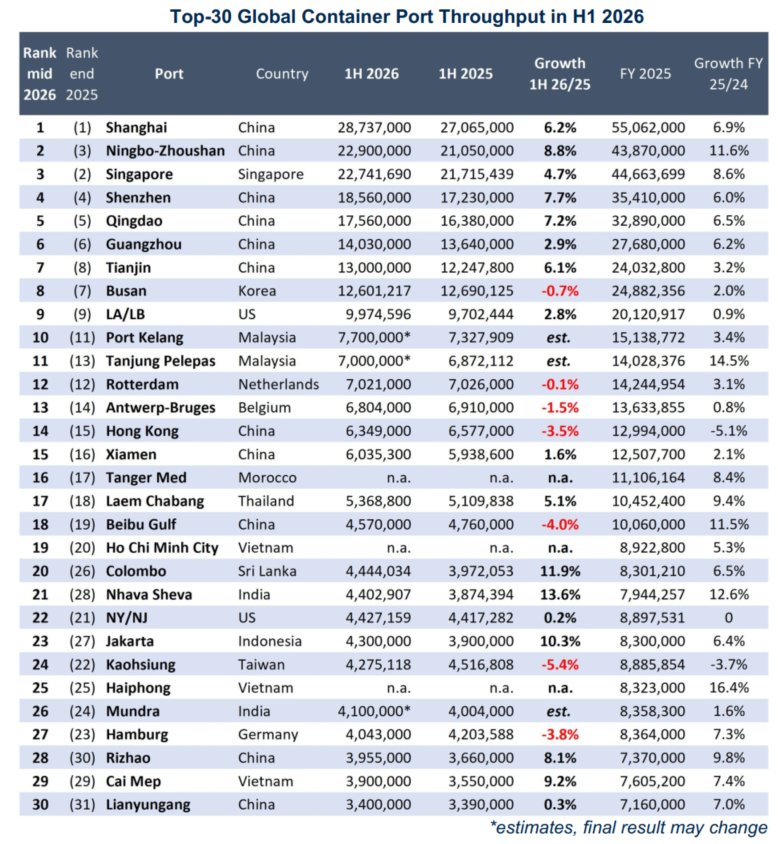
Global port rankings saw major changes in the first half of the year as geopolitical disruption reshaped container flows, according to Alphaliner.
A review of the top-30 ports at the half-year mark shows the widespread impact of geopolitical trends on the global container market, as carriers adjusted their networks in reaction to the Middle East conflict and shippers responded to the US tariff policy.
The effect of renewed disruption in the Hormuz Strait, which resulted in a near shutdown of the waterway from March onwards and only a partial and unstable reopening in June, saw volumes plummet over 90% at Dubai’s Jebel Ali to just 374,000 teu in the second quarter of the year:
Combined with a Q1 decline of 23%, Dubai’s flagship port handled a total 3.14 Mteu in the first six months of the year, less than half the 7.77 Mteu recorded a year earlier. As a result, the port fell out of the top-30, dropping from 10th place to 32nd.
Abu Dhabi’s Khalifa Seaport also saw a major contraction. Operator AD Ports did not release official figures, but based on wider group results, it is thought volumes fell at least 50%, pushing Khalifa out of the top-50 from its previous position at 32nd.
It contrasts with 2025, when the port registered year-on-year growth of 21.4%, challenging Lianyungang for a top-30 place.