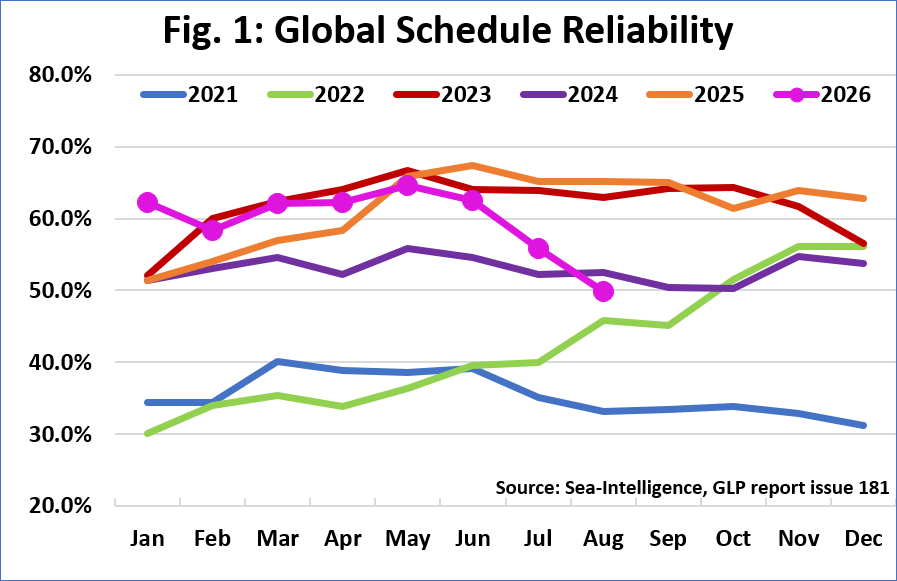

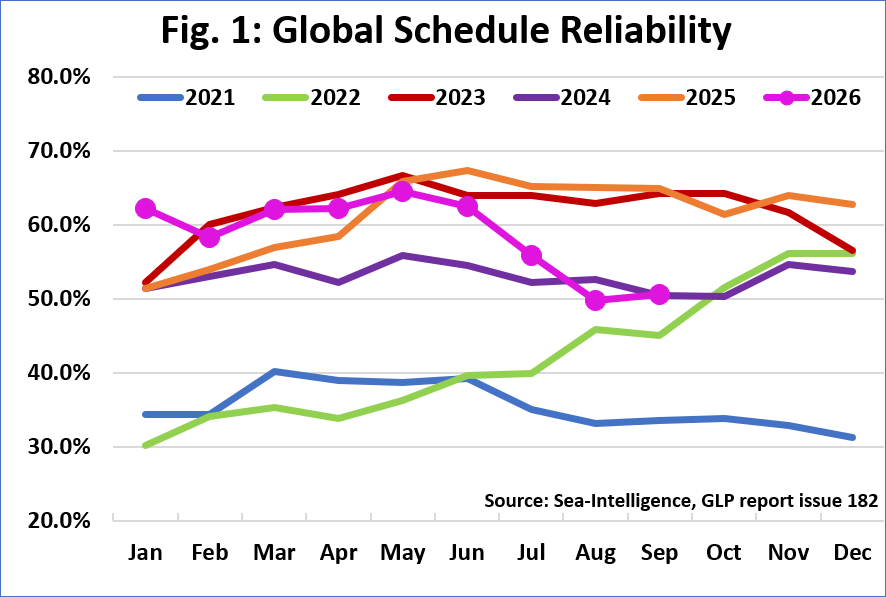
Global schedule reliability improved slightly in September 2026, ending a three-month run of consecutive declines, according to the latest Sea-Intelligence Global Liner Performance data.
Sea-Intelligence reported that schedule reliability increased by 0.9 percentage points month on month to 50.6% in September. The improvement followed three consecutive monthly declines that had reduced reliability by a combined 14.8 percentage points from the May peak of 64.5%.
The average delay for late vessel arrivals also improved, falling by 0.30 days month on month to 6.65 days. Despite the decline, Sea-Intelligence noted that September’s average delay remained the second-highest recorded for the month.
Among the top 13 carriers, Maersk was the most reliable in September at 64.8%, followed by Hapag-Lloyd at 60.4%. MSC recorded 57.7%, while CMA CGM reached 51.8%. At the other end of the ranking, Wan Hai had the lowest reliability at 26.7%.
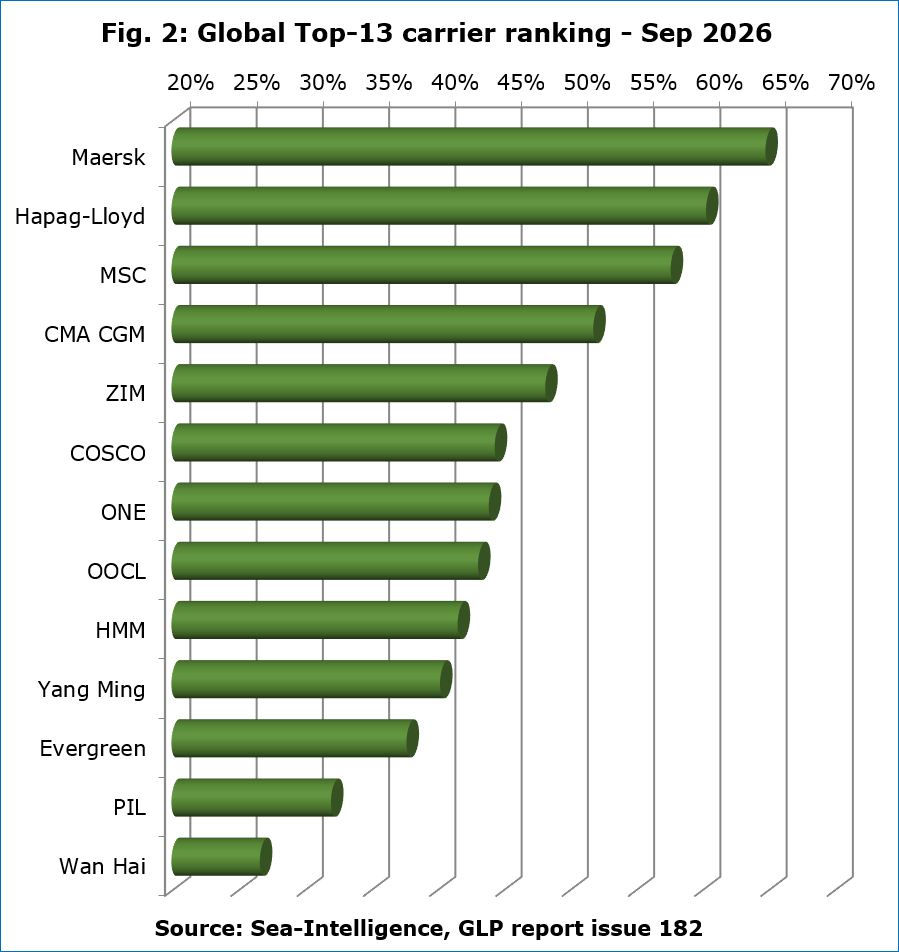
Ten of the 13 carriers improved month on month, with ZIM recording the largest gain at 4.7 percentage points. Maersk posted the largest monthly decline at 1.8 percentage points.
Year-on-year comparisons were weaker. None of the top 13 carriers improved against September 2025, while PIL recorded the largest decline at 27.3 percentage points. Twelve carriers registered double-digit year-on-year decreases.
At alliance level, MSC was the most reliable in August/September 2026 at 68.9%, narrowly ahead of Gemini at 68.4%. Ocean Alliance recorded 44.8%, while Premier Alliance ranked lowest at 41.5%.