Panamax container ships continue to occupy a distinct position in global liner shipping, shaped by Panama Canal constraints and regional deployment strategies, as outlined in this overview by AlphaLiner.
Technically, the term Panamax refers to a ship that fully matches the maximum lock dimensions of the Panama Canal. In practice, shipping terminology is more flexible, and the label is often applied to vessels that are 13 container rows wide, or about 32.30 m, with lengths that are close to the Canal’s 294.00 m limit. In this review, Alphaliner focuses on ships that are 259.00 m or longer.
Broadly speaking, there are two main categories of Panamax container ships. The Maxi Panamax makes full use of the Canal’s restrictions and typically carries more than 5,000 teu. The Baby Panamax is about 30.00 m shorter, roughly two container bays, and normally carries about 4,300 teu.
When looking at carriers and their Panamax fleets, it is important to note that the ranking of the top ten operators differs from the ranking of the top ten carriers.
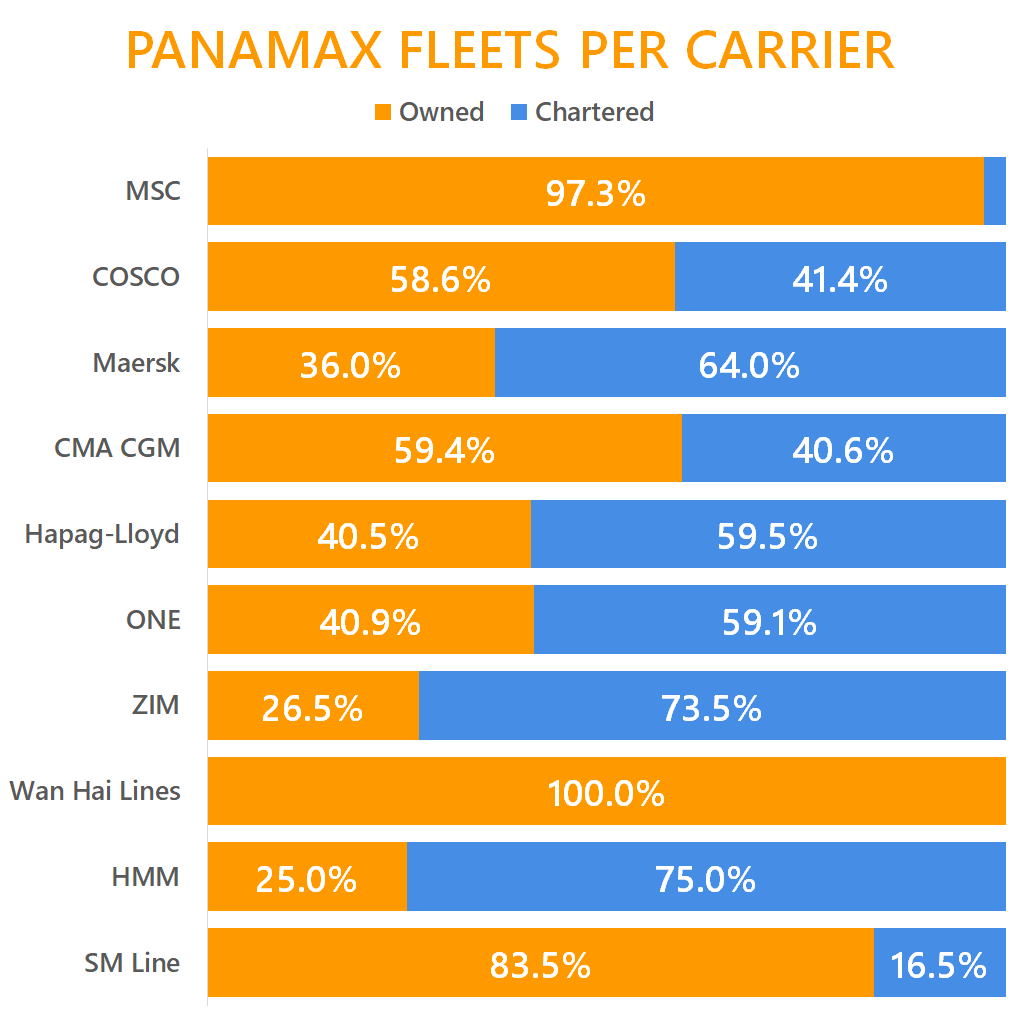
MSCCargo has built a large PMX fleet with 107 ships. Many of these Panamax vessels were acquired second-hand, often purchased at lower asset prices.
Evergreen, founded in 1968, was once a major supporter of the Panamax segment. The company gained prominence in the 1980s with fast and reliable round-the-world services through the Panama Canal. Evergreen operated several series of Panamax vessels, most of them built in Japan. Today, however, the Taiwanese carrier, currently ranked seventh globally, has almost entirely phased out its classic Panamax ships.
COSCOSHIPPING Group, including OOCL, ranks as the clear number two in Panamax operations. Unlike MSC, which bought many of its ships in the second-hand market, COSCO mostly builds or charters these vessels. The group’s strength in this size segment reflects its strong position in markets where Panamax-class ships are well suited. These include longer intra-Asia routes and extended regional services that connect the Far East with India, Africa, and Australia or New Zealand.
When comparing vessel types, Wan Hai and HMM show opposite preferences. Wan Hai operates ten Baby Panamax units of about 4,300 teu, all deployed within Asia, so none of them actually transits the Canal. HMM, on the other hand, operates eight Maxi Panamax ships that mainly trade in the Pacific, including on services to the United States East Coast via the Panama Canal.