The India Middle East Europe Economic Corridor (IMEC) could replace around 60% of the container traffic that currently passes through the Strait of Hormuz if expanded into a network of interconnected trade corridors, according to a new report by the Atlantic Council, authored by William F. Wechsler, Ahmed Aboudouh and Jonathan Panikoff.
The report argues that recent disruptions caused by Houthi attacks in the Red Sea and the temporary closure of the Strait of Hormuz have demonstrated the vulnerability of relying on a limited number of maritime chokepoints.
Rather than depending on a single transport corridor, the authors propose transforming IMEC into a resilient network linking Oman, Saudi Arabia, Egypt and, eventually, Syria through integrated road, rail and port infrastructure.
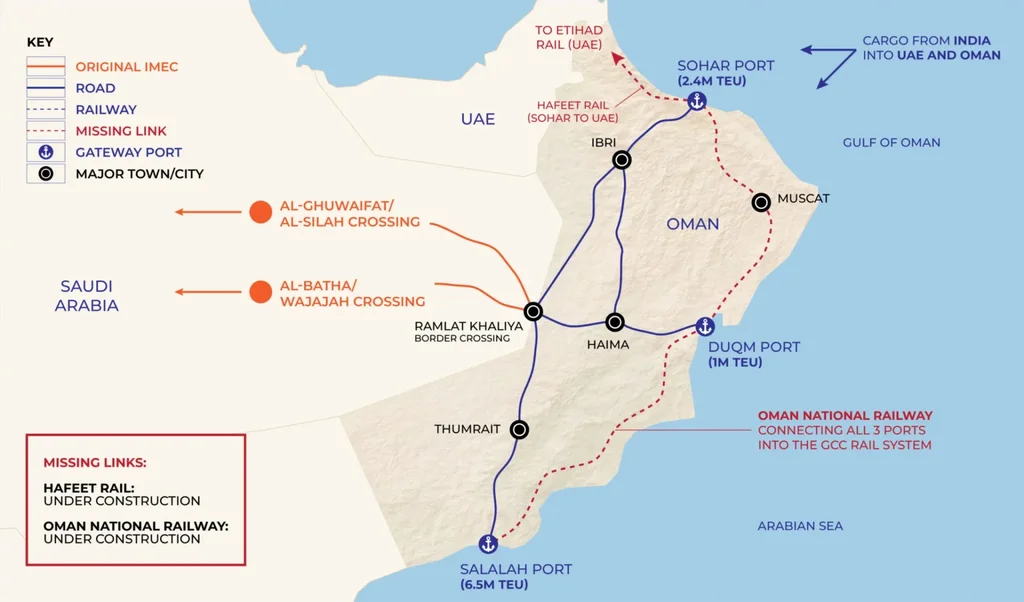
Under the proposed approach, Oman would provide an alternative gateway for cargo arriving from India, with new rail connections linking the ports of Sohar, Duqm and Salalah into the wider GCC railway network.
Saudi Arabia would strengthen east-west connectivity through projects such as the Saudi Landbridge, while Egypt would connect Red Sea and Mediterranean ports through upgraded rail infrastructure.
In the longer term, a reconstructed Syrian transport network could provide an additional corridor to Mediterranean ports, further improving supply chain resilience.
According to the report, developing these interconnected corridors could unlock more than $330 billion in additional trade while significantly reducing dependence on the Strait of Hormuz during periods of geopolitical instability.
The authors argue that the objective is not to replace maritime shipping, but to provide governments, cargo owners and logistics providers with alternative routes when traditional shipping lanes are disrupted.
For the maritime sector, the report highlights how ports, shipping companies, freight forwarders and infrastructure investors are increasingly viewing network redundancy as an essential component of supply chain security.
As geopolitical risks continue to reshape global trade patterns, the evolution of IMEC from a single corridor into a diversified transport network could become one of the most significant logistics developments of the coming decade.
Source: Atlantic Council (30 June 2026), A Network of Corridors Is the Only Reliable Hedge Against Middle East Chokepoint Disruptions. To read the complete analysis, please click here