Suez Canal traffic continues to decline as Red Sea security risks disrupt normal shipping patterns and delay a full recovery in vessel transits.
While several carriers have announced a return to the Suez Canal, AIS-backed traffic data shows the recovery is still developing.
Overall monthly traffic via the Red Sea registered further year-over-year decreases in both December 2025 and January 2026.
The final month of last year saw a relatively minor YoY drop, with 158 crossings recorded compared to 161 during the same period in 2024.
However, the first month of 2026 registered the weakest traffic observed in any January of the past decade, with a total of 150 container ship transits in either direction through the Suez Canal marking a 16.7% YoY decline.
With half of February already behind us, current AIS traffic data indicates we are heading toward a fifth consecutive month of year-over-year declines, despite the much-touted ceasefire signed last October.
That said, some interesting shifts are emerging at a more granular level.
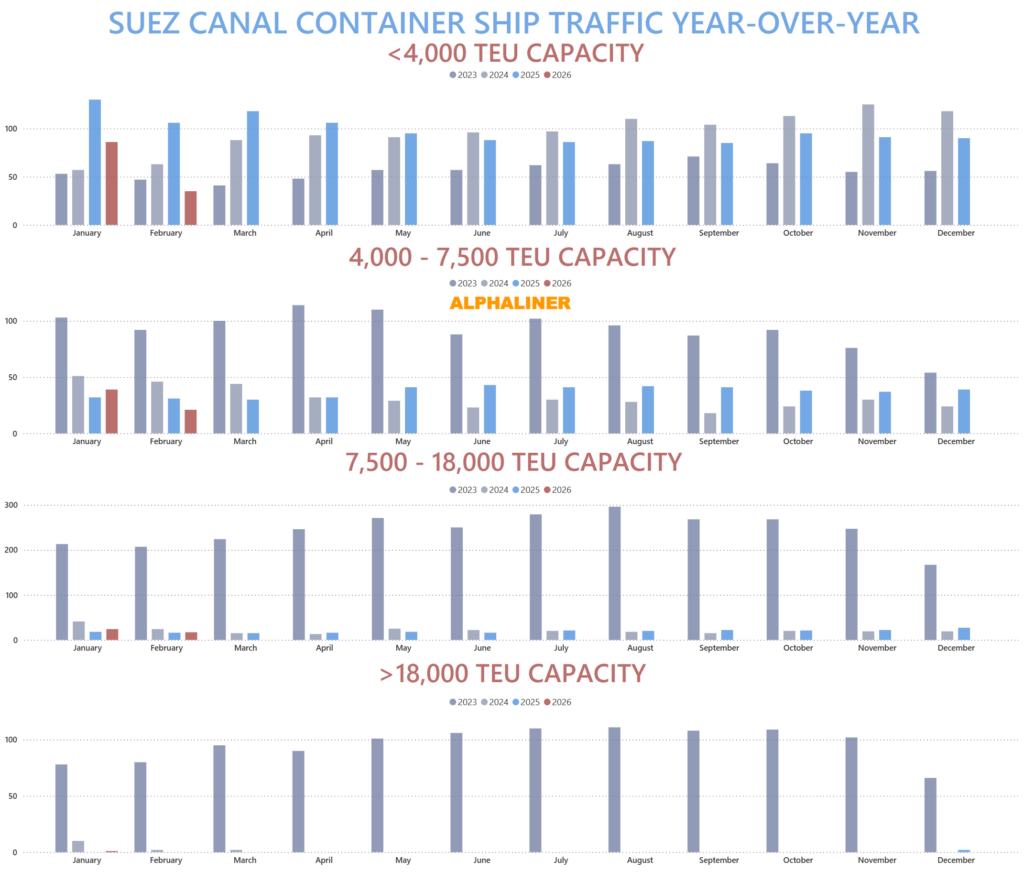
Vessels smaller than 4,000 TEU, the segment that “benefited” the most from the Red Sea crisis, account for the bulk of the overall traffic drop over the past several months. These smaller container ships recorded 90 canal passages in December 2025 and 86 in January 2026, representing a 33.8% YoY decrease in January alone.
Of course, these voyage counts remain significantly higher than the segment’s typical performance prior to the Red Sea crisis.
Container ships between 4,000 TEU and 7,500 TEU continue to hold relatively steady at around 40 crossings per month, translating into YoY increases of 62.5% in December 2025 and 21.9% in January.
Larger vessels between 7,500 TEU and 18,000 TEU have also been cautiously returning since last July, with more than 50 voyages through the Suez Canal recorded over the past two months. Even so, this remains a far cry from the nearly 300 crossings registered in August 2023.
True ULCS / Megamax container ships (18,000+ TEU) crossed the Suez Canal for the first time in more than 20 consecutive months last December, with another transit observed in January.
Source: Alphaliner