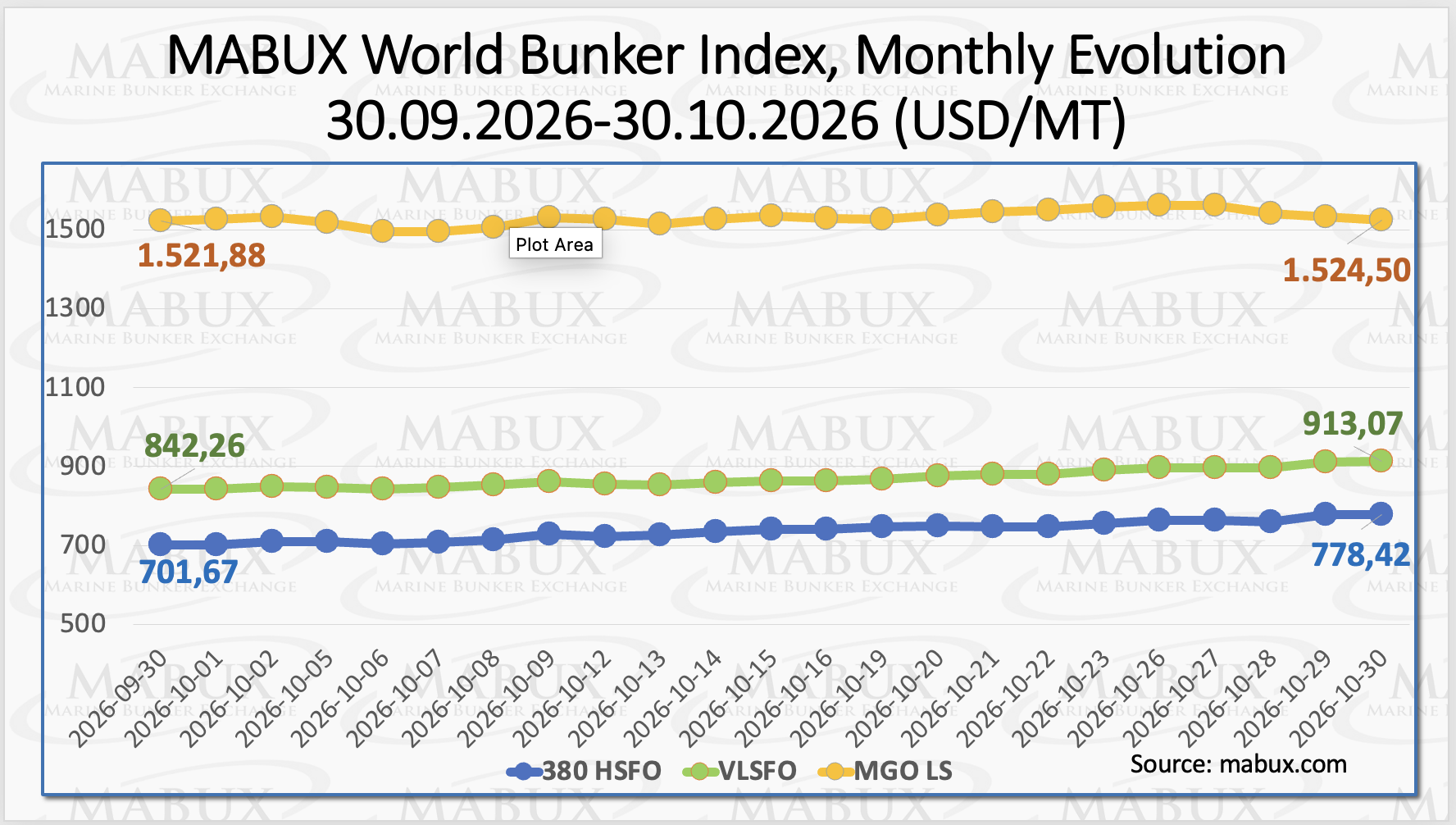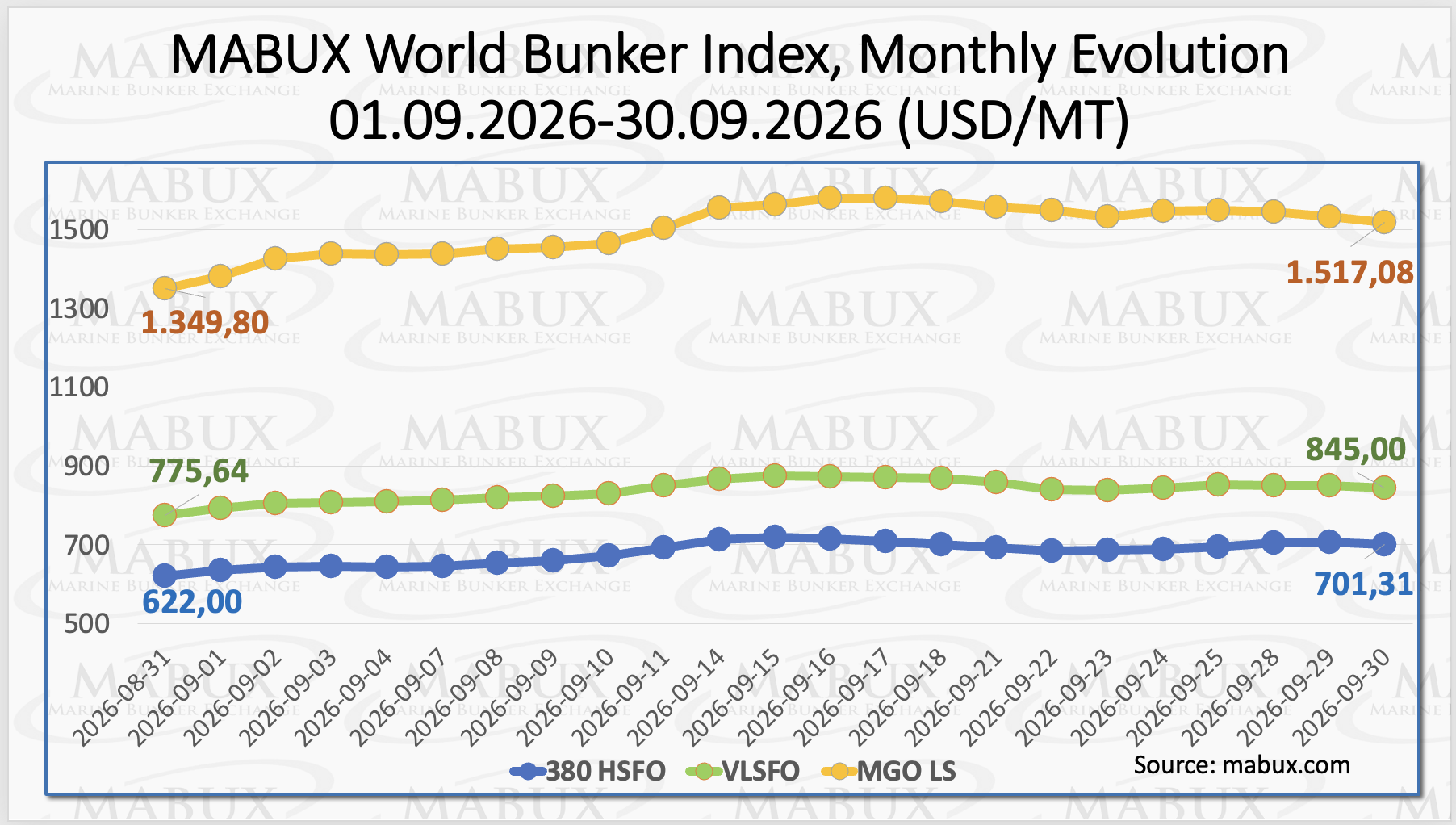


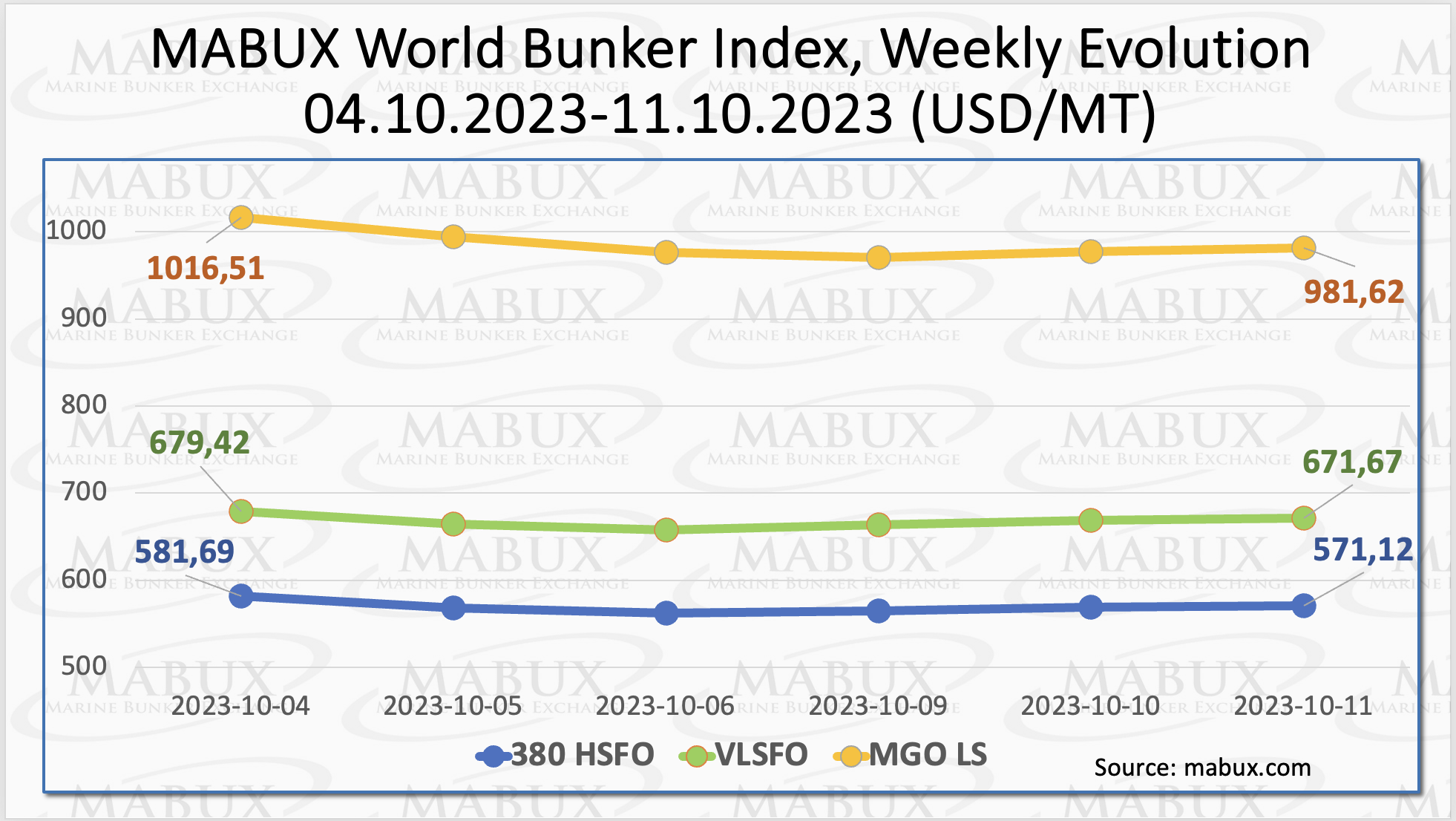
During Week 41, the MABUX global bunker indices showed a moderate downward trend. The 380 HSFO index declined by 10.57 USD: from 581.69 USD/MT last week to 571.12 USD/MT. The VLSFO index also experienced a loss of 7.75 USD (671.67 USD/MT versus 679.42 USD/MT last week). The MGO index saw the most significant price decrease, plummeting by 34.89 USD, from 1016.51 USD/MT to 981.62 USD/MT, breaking the $1000 mark for the first time since September 5, 2023. At the time of writing, a slight upward trend prevailed in the market amid the escalation of Arab-Israeli conflict.
 Global Scrubber Spread (SS) – the price difference between 380 HSFO and VLSFO – showed a slight increase: plus 2.82 ($100.55 versus $97.73 last week), breaking again the $100.00 mark (SS breakeven). The global weekly average also increased by $2.06. In Rotterdam, SS Spread rose by $14.00 (from $68.00 last week to $82.00), while the weekly average added $34.33. However, in Singapore, the price difference between 380 HSFO and VLSFO decreased by $2.00 ($170.00 versus $172.00 the previous week), while the weekly average increased by $15.33. We expect that due to high volatility in the fuel market, SS Spread may continue to grow moderately in the coming week. More information is available in the “Differentials” section of mabux.com.
 Europe’s underground natural gas storages are steadily increasing and are now approaching 97% of their total capacity. The targeted storage capacity of 90% for the upcoming heating season was already reached in August. If the current storage rates continue, it may surpass the all-time record for underground gas storage occupancy by mid-October. Meantime, liquefied natural gas (LNG) imports into Europe have declined to their lowest levels since February 2022, with terminals operating at just 41% of their maximum capacity. Furthermore, on October 10, the gas price in Europe sharply increased of over 10%, surpassing 49 euros per MWh. This surge was attributed to the temporary closure of the Balticconnector gas pipeline between Finland and Estonia due to a leak. Additionally, the market may be affected by the worsening situation in the Middle East.
The price of LNG as bunker fuel in the port of Sines (Portugal) showed an uptrend and reached 861 USD/MT on October 09 (plus 60 USD compared to the previous week). At the same time, the difference in price between LNG and traditional fuel on October 09 has decreased sharply: 112 USD in favor of LNG versus 262 USD a week earlier: MGO LS was quoted that day in the port of Sines at 973 USD/MT. More information is available in the LNG Bunkering section of mabux.com.
 Over the Week 41, the MDI index (the ratio of market bunker prices (MABUX MBP Index) to the digital bunker benchmark MABUX (MABUX DBP Index)) continued to record underpricing for all types of bunker fuels in all selected ports.
In the 380 HSFO segment, the average weekly underpricing increased by 16 points in Rotterdam, by 12 points in Singapore, by 15 points in Fujairah and by 12 points in Houston. In Fujairah, the level of fuel underpricing exceeded the $100.00 mark.
In the VLSFO segment, according to MDI, the average undervaluation increased only in Houston – plus 2 points. In the other three ports, MDI narrowed by 20 points in Rotterdam, by 13 points in Singapore and by 19 points in Fujairah. In Singapore, MDI values approached the 100% correlation mark between market prices and the digital benchmark.
In the MGO LS segment, the average underpricing premium decreased in Rotterdam by 8 points and in Fujairah by 23 points, but increased in Singapore by 4 points and in Houston by 7 points. In Singapore and Fujairah, fuel underpricing exceeded $100.00.
 More information on the correlation between market prices and the MABUX digital benchmark is available in the “Digital Bunker Prices” section of mabux.com.
In support of the Zero Emissions Maritime Buyers Alliance (ZEMBA), the Port of Rotterdam has announced a significant reduction in port fees for vessels bunkering sustainable fuels at the maritime hub in the Netherlands. To be eligible for this new initiative, ships must bunker alternative fuels in Rotterdam that result in a minimum 90% reduction in greenhouse gas emissions, such as green methanol or ammonia. It’s important to note that the discount will not be applicable to bio-blended fuel oil, marine gas oil (MGO), or marine diesel oil (MDO), as these markets are already well-established in Rotterdam. The Port of Rotterdam already provides discounts to ships that achieve high scores on the Environmental Ship Index (ESI). Additionally, last year, it collaborated with the Maritime Port Authority of Singapore (MPA) to launch the Green & Digital Corridor project, which offers incentives to carriers using sustainable fuels on the Singapore-Rotterdam trade route.
We expect that next week the global bunker market will be dominated by an upward trend due to the escalating conflict in the Middle East.
Source: www.mabux.com